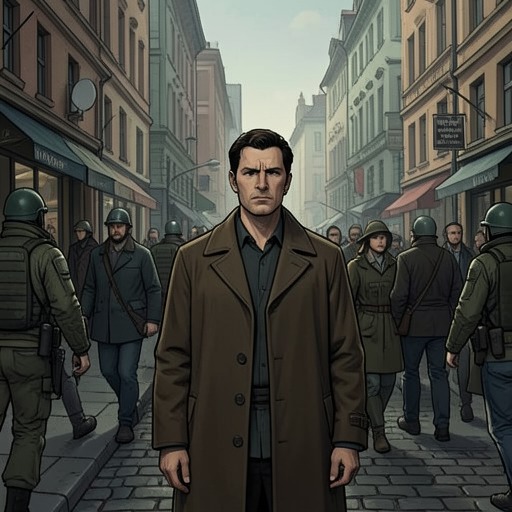
The right to be unhappy
Brave New WorldThe right to be unhappy is John’s challenge to the World State’s equation of happiness with social stability. In his debate with Mustapha Mond, he claims the freedom to choose poetry, danger, God, goodness, and sin—and to accept the suffering that such freedom entails. The exchange makes his position more than a rejection of comfort: it exposes the cost of a system that protects people by narrowing what they can want and experience.
The dispute over stability
Mustapha Mond argues that the World State cannot sustain the conditions that produced Shakespearean tragedy. Its citizens are kept safe and content, and social conditioning directs them toward approved behavior; when distress threatens, soma offers relief. In Mond’s account, tragedies require social instability, while the settled world has eliminated the passions and relationships that once gave such works their force.
John answers that Shakespeare’s Othello is better than the feelies. Mond agrees about its artistic value, but says the society has sacrificed high art for stability, offering the feelies and the scent organ instead. Their disagreement is not simply about taste: the feelies provide agreeable sensations, while tragedy asks its audience to encounter meanings and emotions that cannot be reduced to comfort.
Comfort as public policy
Mond’s defense extends beyond entertainment. He maintains that lower-caste workers could technically be given shorter working hours, but cites an experiment in which all of Ireland was put on a four-hour day. Rather than becoming happier, the population grew restless and consumed more soma; the additional leisure itself became something people wanted to escape. The state therefore withholds both leisure and labor-saving inventions, reasoning that too much free time would harm the people it governs.
The same reasoning shapes production. Mond says the state could synthesize all its food, but keeps a third of the population in agriculture because obtaining food from the land takes longer than producing it in a factory. Change, including discoveries in pure science, is treated as a threat to stability. These examples clarify the paternalism beneath the promise of happiness: institutions decide which conditions people should live under, then use the resulting habits as evidence that those conditions suit them.
Claiming the costs of freedom
The immediate exchange turns on the Violent Passion Surrogate, a monthly treatment that floods the body with adrenin and reproduces the physiological effects of fear and rage without their accompanying dangers. When Mond says the state prefers comfort, John rejects the premise that comfort is what everyone ought to want. He names God, poetry, real danger, freedom, goodness, and sin as things he wants, and Mond identifies the implication: John is claiming the right to be unhappy.
John accepts that description and expands it. His claim includes the right to grow old, to face illness, hunger, uncertainty, and pain. These are not presented as desirable in themselves so much as inseparable from a freedom that cannot be guaranteed to remain pleasant. After a long silence, he says he claims them all; Mond replies that he is welcome to them.
Significance
The phrase condenses the novel’s conflict between security imposed from above and a person’s right to choose a life whose outcomes cannot be controlled. Mond treats suffering as a preventable cost and happiness as a public result to be managed. John refuses that calculation: a life without risk may also exclude the experiences, art, and moral choices that make freedom meaningful. His answer therefore tests the World State’s central promise, showing how its version of happiness depends on ruling out not only misery but also the possibility of wanting something beyond comfort.